Facebook Lead Ads vs. Landing Pages: Which Brings Better Property Buyers?
Facebook lead ads vs landing pages for real estate: cost per lead versus lead quality, when each wins, a hybrid setup, and how to track which one brings buyers.
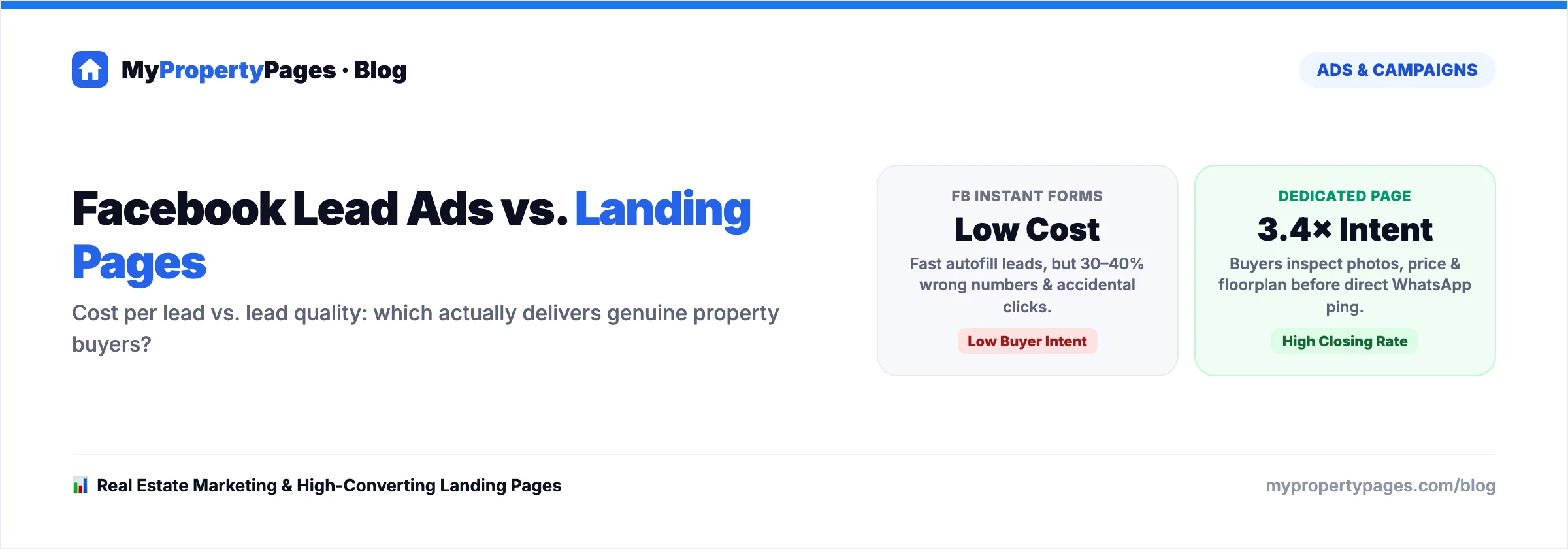
You run a ₹5,000 campaign for a 3BHK. Version one uses Facebook's instant form and brings 40 leads at roughly ₹125 each. Version two sends people to a property page and brings 11 leads at roughly ₹450 each. On paper version one wins by a mile. Then you call the 40 and eight pick up, three remember the ad, one agrees to a visit. You call the 11 and seven pick up, five remember, three visit. The Facebook lead ads vs. landing pages debate is really a debate about what you are paying for: names, or buyers.
This guide lays out how each actually behaves for Indian property agents, when each one is the right choice, and how to set up a hybrid that gets you volume without drowning in junk.
How the two formats differ in practice
Facebook (Meta) lead ads
The user taps the ad and a form opens inside Facebook or Instagram, pre-filled with their name, phone and email from their profile. Two taps and they are done. They never see your listing in detail, never leave the app, and often never remember doing it.
Landing-page ads
The user taps the ad and goes to a page you control: photos, price, floor plan, video, map, brochure and an enquiry form or WhatsApp button. They have to read, scroll and type. Fewer people finish, but the ones who do have seen the property and chosen to contact you.
Where lead ads win
- Volume at launch. A new project or a fresh batch of plots where you need 200 names this week for a telecalling team. Lead ads fill a list fast.
- Low-friction audiences. Users on slow mobile data who would abandon a page that takes six seconds to load.
- Database building. If your plan is a six-month nurture sequence rather than a sale this week, cheap names are fine as long as you have a system to warm them. See our guide to lead nurturing over long buying cycles if that is your model.
- Simplicity. No page to build, no pixel to install. Good for an agent testing an area for the first time.
Where landing pages win
- Lead quality. The buyer has seen the price and location before contacting you. Your "wrong number, not interested" rate drops sharply.
- Price-sensitive inventory. If a flat is ₹1.4 crore, you want the buyer to know that before they submit. Lead ads hide the price behind the form; the page shows it.
- Trust. A page with your photo, RERA number, reviews and a walkthrough video does the first ten minutes of rapport for you. A lead form does none of it.
- Retargeting. Only a page lets you install the Meta Pixel and re-show the ad to the 95% who visited and did not enquire. Our explainer on Meta Pixel for real estate covers the setup.
- Measurement. With UTM links you know which ad, which creative and which audience produced the enquiry that became a site visit, not just a name.
The hidden costs people forget
Lead ads cost you time. Forty leads at ₹125 is ₹5,000 in ad spend plus roughly four to six hours of calling, most of it wasted. If you value your time at all, the real cost per usable lead is much higher than the dashboard shows.
Landing pages cost you preparation. A bad page (slow, no price, stock photos, form that emails you the next morning) will underperform a lead ad. The page has to be good and the enquiry has to reach you within minutes. A page with a broken form is the most expensive ad you will ever run.
Both cost you if you are slow. Whatever format you pick, a lead that waits two hours for a reply is a lead shared with three other agents. Speed beats format.
A hybrid that works for most agents
You do not have to choose permanently. A setup many agents settle into:
- Build one property page per listing with price, photos, video, brochure PDF and a WhatsApp button. On My Property Pages every listing gets its own page and the enquiry lands in your inbox with a push notification, which solves the "form emailed me next morning" problem. You can start with a free property page and upgrade when you need tracking.
- Install the Meta Pixel and Google Analytics on the page (a Pages plan lets you paste the Pixel and GA code straight in).
- Run landing-page ads as the default for resale flats, villas and premium plots, where quality matters more than count.
- Run lead ads only for launches and bulk inventory, and add two custom questions to the form: budget band and "when are you planning to buy?". Custom questions cut volume and raise quality, which is what you want.
- Retarget page visitors with a lead ad. Someone who spent 40 seconds on the page and left is a warm prospect; a low-friction form is the right next step for them.
- Tag every ad with a UTM link so the source shows up against each lead. Our piece on UTM tracking for real estate ads shows the naming scheme.
What to measure (not cost per lead)
Cost per lead is the number Facebook shows you because it is the number that makes Facebook look good. Track these instead, per campaign:
- Connect rate: leads who picked up or replied within 48 hours.
- Recall rate: leads who remembered the property when you called. Low recall is the signature of a lead-ad audience.
- Site-visit rate: leads who actually came to see it.
- Cost per site visit: ad spend divided by visits. This is the number to compare formats on.
- Closures, eventually, because a format that produces many visits but no buyers is also wrong.
If your CRM has stages (New, Contacted, Site visit, Negotiation, Won), these numbers fall out of it automatically. If you are still on a spreadsheet, add a "source" column today.
A worked example
Say an agent runs both formats for the same 2BHK in Zirakpur over two weeks with ₹6,000 each.
- Lead ads: roughly 45 leads, 12 connected, 4 remembered, 2 visits. Cost per visit roughly ₹3,000.
- Landing page: roughly 13 leads, 9 connected, 8 remembered, 4 visits. Cost per visit roughly ₹1,500, and two of the four visitors asked about a second listing on the agent's profile page.
The figures are illustrative, not a study, and your numbers will differ by city, creative and price band. But the pattern is typical: the page costs more per name and less per buyer, and it builds something (a pixel audience, a profile with reviews) that the form never does.
Creative notes that apply to both
- Lead with the price or the price band in the ad. It filters for you.
- Use real photos, ideally one wide shot of the best room and one of the building. Our comparison of photos, video and carousel creatives covers what tends to perform.
- Say the location precisely: "Sector 70, Mohali" not "prime Tricity location".
- In the ad text, tell the user exactly what happens next: "Tap to see photos, price and book a visit" for the page; "Tap and we will WhatsApp you the brochure" for the form. Then actually do that within minutes.
Pick the format by the job. Names for a telecalling team: lead ads. Buyers for a listing you want to close this month: a good page, a fast reply and the pixel running in the background.
Frequently asked questions
Why are Facebook lead ads so cheap per lead but so hard to convert?
Because the form is pre-filled and the user never leaves Facebook, so people submit with almost no intent. Many do not remember filling it. You pay less per name and more per real buyer.
Do I need a website to run landing-page ads for a property?
No. A single property page with photos, price, brochure and an enquiry form is enough, as long as it loads fast on mobile and the enquiry reaches you instantly.
Which should a solo agent with a small budget start with?
Start with landing-page ads to one property page with the Meta Pixel installed, because you learn what buyers actually respond to. Add lead ads later for volume on a project launch, and qualify them with a quick question.
Put your next listing on its own page
Free to start: 2 property pages, your agent profile, and every enquiry straight to your phone. The Pages plan adds a sales team, a mini CRM and a follow-up bot for $19.99 a month.
Create your free page See a sample agent pageTools & comparisons
Property Portals vs Your Own Landing Page
How lead distribution works on property listing portals, why the same buyer enquiry often reaches several agents, and wh…
ComparePortal Listing vs Your WhatsApp Landing Page
A practical comparison of listing on a property portal against running your own WhatsApp landing page: cost per lead, le…
Free toolsProperty calculators
EMI, stamp duty by state, rental yield, capital gains and more — free, no sign-up.
Keep reading
Meta Pixel for Real Estate: Track Which Ad Actually Brought the Buyer
How to set up Meta Pixel for real estate property pages: which events to fire, how to read which Facebook or Instagram ad brought the enquiry, and how to use it for retargeting.
Ads & campaignsWhat a Property Enquiry Is Actually Worth
Work out what you can afford to pay for an enquiry, and most advertising decisions answer themselves. The arithmetic, and the three numbers most agents have never measured.
Ads & campaignsRetargeting for Property Listings: Bringing Back Visitors Who Didn't Enquire
Retargeting for property listings explained for agents: how to set up the Meta Pixel on your pages, build audiences of visitors who did not enquire, and win them back.