First-Time Home Buyer Checklist for India: Documents, Loans and Red Flags
A first-time home buyer checklist for India covering the documents to verify, how to get loan-ready, and the red flags that should make you walk away from a deal.
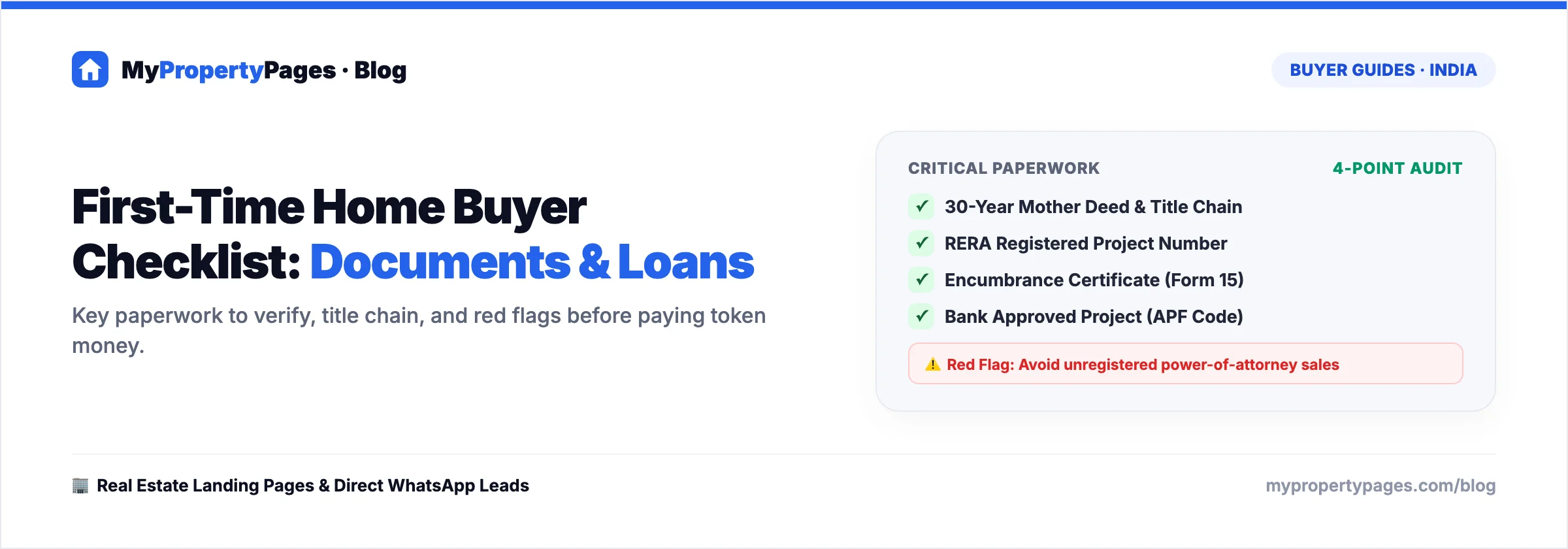
Buying your first home in India is a paperwork exercise disguised as an emotional decision. The flat you like is the easy part. What decides whether you sleep well for the next twenty years is whether the title is clean, the loan is structured sensibly and you walked away from the one deal that looked too good. This first-time home buyer checklist for India is organised in the order you will actually need it: before you search, while you shortlist, before you pay a token, and at registration.
Before you search: get your money straight
Know your real budget
Your budget is not "what the bank will lend". It is what you can pay every month without your life becoming a spreadsheet. A widely used rule of thumb is to keep total EMIs within roughly 35% to 40% of take-home income. Use your bank's eligibility calculator, then cut the number by 10% to 15% for comfort.
Separately, set aside:
- Down payment: typically 10% to 25% of the price, depending on the lender and loan size.
- Transaction costs: stamp duty, registration, legal fees, society transfer and loan charges, roughly 8% to 12% of the price. The guide to stamp duty and registration charges at Stamp Duty and Registration Charges: How to Estimate Your Total Cost walks through the estimate.
- Interiors and moving: easy to forget, rarely small.
Get pre-approved
A pre-approval (or in-principle sanction) takes a few days and usually needs:
- PAN and Aadhaar
- Three to six months of salary slips and bank statements (or two to three years of ITRs if self-employed)
- Form 16 or ITR acknowledgements
- Employer ID and address proof
With a sanction letter in hand you negotiate differently, and sellers and agents treat you differently. For the details of what banks look at, read home loan eligibility explained simply at Home Loan Eligibility Explained Simply (What Banks Look At).
While you shortlist: the questions that save months
Ask these on the first call or visit. A good agent will have answers ready; a vague one is a signal in itself.
- Is the project RERA registered? What is the number?
- Is it freehold or leasehold? Who is the original allotting authority?
- For resale: how many times has the property changed hands, and is the seller the sole owner?
- Is there an occupancy certificate (OC) for the building and a completion certificate (CC)?
- What are the monthly maintenance charges and is there a sinking fund?
- What is the carpet area, as distinct from super built-up area? Read the difference at Carpet Area vs. Built-Up vs. Super Built-Up: What You Actually Pay For.
- Is the property already mortgaged? If yes, how will the loan be closed at sale?
- Are there any pending society dues, court cases or notices?
Record the answers. You will compare three or four properties and memory is unreliable after the second site visit.
Before you pay a token: documents to verify
Never pay a token amount on the strength of a WhatsApp forward and a verbal assurance. Ask for copies of the following and have a property lawyer (not the seller's lawyer) review them. Budget a few thousand rupees for this; it is the best money you will spend.
For any property
- Title deed(s) and the chain of previous sale deeds going back ideally 12 to 30 years.
- Encumbrance certificate from the sub-registrar for the same period, showing no undisclosed mortgages or claims.
- Latest property tax receipts and utility bills in the seller's name.
- Seller's identity and PAN, and proof that the person signing has the authority to sell (power of attorney, if used, needs careful checking).
- Approved building plan and occupancy certificate.
For a flat in a society
- Share certificate (where applicable) and society membership proof.
- Society NOC for transfer and a dues-clearance letter.
- Details of transfer fees and the society's rules on renting and renovation.
For a plot
- Allotment letter and possession letter from the authority (GMADA, HUDA, DDA, etc.).
- Layout approval, conversion certificate if the land was agricultural, and a recent survey or demarcation. The plot verification guide at How to Verify a Plot Before Buying: Title, Approvals and Encumbrance goes deeper.
For under-construction property
- RERA registration certificate and the project's page on the state RERA portal, including the promised completion date.
- Sanctioned plan, land title in the builder's name or a registered development agreement.
- Builder-buyer agreement draft, reviewed for penalty clauses, delay compensation and area-change provisions.
Red flags that should make you walk away
Not every problem is fatal, but these usually are:
- "Registry will happen later, pay cash now." Cash components invite legal and tax trouble and leave you with no recourse.
- Circle rate far above the asking price. Either the price is suspicious or the duty will surprise you.
- No occupancy certificate in a building that has been occupied for years. Banks may refuse to lend and resale becomes hard.
- Power-of-attorney sales where the original owner is unavailable or the PoA is unregistered.
- Pressure tactics. "Two other buyers are coming this evening" is a script. Genuine demand does not need a deadline.
- Refusal to share documents before the token. A seller with clean papers has nothing to hide.
- Inconsistent areas. The brochure says one figure, the deed says another, the agent says a third.
- Agent who will not share a RERA number or a stable professional profile. A registered agent with a public page and client reviews, like the example at a live agent page, has a reputation to protect; an anonymous number on a flex board does not.
At registration: the final checks
- Read the sale deed line by line. Verify names, PANs, area, price, and the schedule of property.
- Confirm the stamp duty figure against the official calculator and pay through the official channel (e-stamp or franking, as your state requires).
- Take original documents from the seller at the time of registration, not later.
- If there is a loan, understand that the bank will hold the original deed and you will receive a certified copy.
- Apply for mutation (transfer of ownership in municipal or authority records) immediately after registration.
- Get utility connections, society records and property-tax records moved to your name within the first month.
A one-page version to save
- Budget fixed, pre-approval in hand, transaction costs set aside.
- Eight shortlist questions asked and answers written down.
- Title chain, encumbrance certificate, OC, tax receipts and society NOC reviewed by your lawyer.
- No cash component, no pressure deadline, no missing documents.
- Deed read in full, duty paid officially, originals collected, mutation applied.
First-time buyers who follow this list are not slower than everyone else. They just skip the month of panic that usually sits between "we loved it" and "we own it".
Frequently asked questions
What is the first thing a first-time buyer should do?
Get a home-loan pre-approval or at least an eligibility estimate from your bank. It fixes your real budget, tells sellers you are serious, and stops you from falling in love with a flat you cannot finance.
Which documents matter most for a resale flat?
The chain of title deeds, the latest encumbrance certificate, the society NOC and dues clearance, the occupancy certificate for the building, and proof that property tax and utility bills are paid up to date.
How much should I keep aside beyond the down payment?
Roughly 8% to 12% of the price for stamp duty, registration, legal fees, society transfer and loan charges, plus a small cushion for interiors and moving. These are usually not covered by the loan.
Put your next listing on its own page
Free to start: 2 property pages, your agent profile, and every enquiry straight to your phone. The Pages plan adds a sales team, a mini CRM and a follow-up bot for $19.99 a month.
Create your free page See a sample agent pageTools & comparisons
Property Portals vs Your Own Landing Page
How lead distribution works on property listing portals, why the same buyer enquiry often reaches several agents, and wh…
ComparePortal Listing vs Your WhatsApp Landing Page
A practical comparison of listing on a property portal against running your own WhatsApp landing page: cost per lead, le…
Free toolsProperty calculators
EMI, stamp duty by state, rental yield, capital gains and more — free, no sign-up.
Keep reading
Freehold vs. Leasehold Property in India: What It Means for You
Freehold vs leasehold property in India explained plainly: ownership, transfer, loans, conversion and resale, plus the questions to ask before you pay a token.
Buyer guidesRenting vs. Buying in 2026: A Simple Way to Decide
Renting vs buying in 2026 for Indian home seekers: a simple rent-to-price test, the true monthly cost of owning, the five-year rule, and when renting is the smarter choice.
Buyer guidesCIBIL Score 550–649: Can You Get a Home Loan?
A CIBIL score of 550–649 is rated poor. Most banks decline; NBFCs may lend at a significantly higher rate. On a ₹50 lakh loan that costs ₹15.67 lakh more.