Stamp Duty and Registration Charges: How to Estimate Your Total Cost
Stamp duty and registration charges can add several lakh to a home purchase. A step-by-step method to estimate your total cost before you commit to a flat or plot.
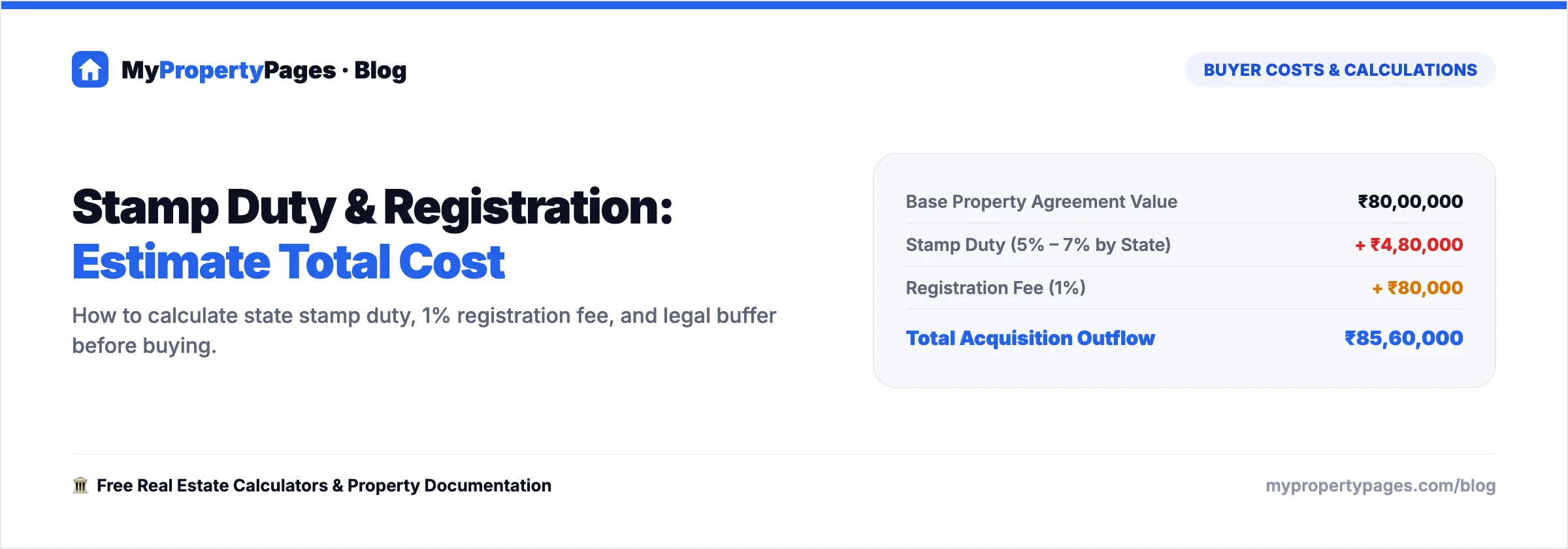
Most buyers budget for the price of the flat and the down payment. Then, a week before registration, they discover that stamp duty and registration charges, plus a handful of smaller fees, need to be paid in full, in cash or DD, and are not covered by the home loan. On a ₹60 lakh flat that surprise is routinely ₹4 to ₹6 lakh. This guide gives you a simple method to estimate your total cost early, so the number at the sub-registrar's office is one you already expected.
What stamp duty and registration charges actually are
Stamp duty is a state tax on the transfer of property. It is charged as a percentage of the property value and varies by state, by city versus rural area, sometimes by gender of the buyer, and occasionally by property type.
Registration charge is the fee for recording the sale deed with the sub-registrar. It is usually a smaller percentage, often with a cap in some states.
Both are state subjects, which is why a flat in Mohali and a flat in Gurugram of the same price carry different costs. Rates change in budgets and through notifications, so treat everything here as a method and check your state's current rates before you finalise.
The value the tax is calculated on
This is where most estimates go wrong. Duty is not always calculated on what you agreed to pay. It is calculated on the higher of:
- the agreement (consideration) value, or
- the government's circle rate (called collector rate in Punjab and Haryana, ready reckoner rate in Maharashtra, guidance value in Karnataka).
If the circle rate for your sector is ₹5,000 per sq ft and you negotiated ₹4,600, the duty is on ₹5,000. Ask your agent or check the district portal for the current circle rate of the exact sector and property type; plots, flats and commercial units often have different rates on the same road.
A step-by-step estimate
Work through these with a calculator. Use rough rates to start, then replace them with the exact figures for your state.
Step 1: Fix the taxable value
Take the higher of your agreement value and the circle-rate value. For a resale flat, circle rate is usually per sq ft of super built-up area times the area in the sale deed. For a plot, it is per sq yard or per marla depending on the state.
Step 2: Apply stamp duty
Across most Indian states stamp duty falls roughly in the 4% to 8% band, with concessions for women buyers in several states. Take your taxable value and multiply by your state's rate. On ₹60 lakh at 6%, that is ₹3.6 lakh.
Step 3: Apply registration charge
Registration is typically around 1% of value, sometimes capped. On ₹60 lakh at 1%, that is ₹60,000.
Step 4: Add the smaller fees
These are easy to forget and add up:
- Legal or deed-drafting fee for the advocate who prepares the sale deed.
- Documentation and facilitation charges, sometimes charged by the sub-registrar's service providers.
- Mutation or transfer fee with the municipal body or development authority (for GMADA, HUDA or society flats this can be a distinct charge).
- Society transfer charges or NOC fees in a resale flat; read the resale flat buying guide at Resale Flat Buying Guide: Society NOC, Dues and Transfer Charges for what to expect.
- Home-loan processing fee, valuation fee and the cost of the MODT (memorandum of deposit of title deed) registration if your bank requires it.
- GST on an under-construction flat, charged by the builder on the agreement value, separate from stamp duty.
Step 5: Add it up
A worked example for a ₹60 lakh resale flat, using illustrative rates only:
| Item | Rough amount |
|---|---|
| Stamp duty at 6% | ₹3,60,000 |
| Registration at 1% | ₹60,000 |
| Deed drafting and documentation | ₹10,000 to ₹25,000 |
| Society transfer and NOC | ₹25,000 to ₹1,00,000 |
| Loan processing, valuation, MODT | ₹15,000 to ₹40,000 |
| Estimated transaction cost | roughly ₹4.7 to ₹5.9 lakh |
That is about 8% to 10% of the price, and it has to come from your own savings because your lender will typically fund a percentage of the property value only.
Where to find your state's actual rates
Every state has a stamps and registration department website, and most now have an online duty calculator. Search for "[state] stamp duty calculator" and use the official portal. Ask your advocate to confirm the figure a week before registration, because notifications can change rates with little public notice. If you are buying in Punjab, the Mohali flat guide at Buying a Flat in Mohali: Sectors, Price Bands and What to Check covers local costs in more detail.
Ways buyers legitimately reduce the bill
- Register in a woman's name or jointly. Several states give a concession of roughly one to two percentage points. Check eligibility and the current rule.
- Check for first-time buyer or affordable-housing schemes. Some states offer reduced duty below a price threshold.
- Time your purchase around state concessions. States occasionally announce temporary reductions to boost registrations.
- Do not under-declare. Writing a lower value in the deed to save duty is illegal, creates capital-gains problems when you sell, and makes the property unbankable. Pay on the real value.
How an agent should present these costs
If you are the agent, the single most useful thing you can do for a buyer is send a one-page cost estimate on day one of serious interest. It builds trust and prevents deals collapsing at registration because the buyer is ₹4 lakh short. A property page with a short "estimated costs" note, or a brochure PDF attached to the listing, does this for you on every lead. Agents using a free property page on My Property Pages often add a line like "Indicative stamp duty and registration: approximately ₹X; final figure depends on current state rates." That one sentence saves a lot of last-minute calls.
A buyer's checklist before you commit
- Find the circle rate for the exact sector and property type.
- Confirm your state's current stamp duty and registration rates on the official portal.
- Ask the society or builder in writing for all transfer charges and dues.
- Get your bank's processing, valuation and MODT charges in writing.
- Add roughly 1% of the price as a buffer for surprises.
- Make sure this total is in liquid savings, separate from your down payment.
Do that before you pay the token amount and the registration day becomes a formality rather than a scramble.
Frequently asked questions
Is stamp duty charged on the agreement value or the circle rate?
On whichever is higher. If you negotiate a price below the government circle rate (also called collector rate or guidance value), duty is still calculated on the circle rate, so check it before assuming a discount lowers your tax.
Can stamp duty and registration charges be included in my home loan?
Typically no. Most lenders fund only a percentage of the property value and exclude duty, registration and other transaction costs, so plan to pay these from your own funds. Confirm with your specific bank.
Do women buyers get a lower stamp duty rate?
Several states offer a concession of roughly one to two percentage points when the property is registered in a woman's name or jointly with a woman. Rules differ and change, so check your state's current rates.
Put your next listing on its own page
Free to start: 2 property pages, your agent profile, and every enquiry straight to your phone. The Pages plan adds a sales team, a mini CRM and a follow-up bot for $19.99 a month.
Create your free page See a sample agent pageTools & comparisons
Property Portals vs Your Own Landing Page
How lead distribution works on property listing portals, why the same buyer enquiry often reaches several agents, and wh…
ComparePortal Listing vs Your WhatsApp Landing Page
A practical comparison of listing on a property portal against running your own WhatsApp landing page: cost per lead, le…
Free toolsProperty calculators
EMI, stamp duty by state, rental yield, capital gains and more — free, no sign-up.
Keep reading
Freehold vs. Leasehold Property in India: What It Means for You
Freehold vs leasehold property in India explained plainly: ownership, transfer, loans, conversion and resale, plus the questions to ask before you pay a token.
Buyer guidesRenting vs. Buying in 2026: A Simple Way to Decide
Renting vs buying in 2026 for Indian home seekers: a simple rent-to-price test, the true monthly cost of owning, the five-year rule, and when renting is the smarter choice.
Buyer guidesCIBIL Score 550–649: Can You Get a Home Loan?
A CIBIL score of 550–649 is rated poor. Most banks decline; NBFCs may lend at a significantly higher rate. On a ₹50 lakh loan that costs ₹15.67 lakh more.