What Buyers Do in the First Eight Seconds on a Listing Page
The order buyers read a property page in, why the hero photo decides everything after it, and the four things that make someone leave before scrolling.
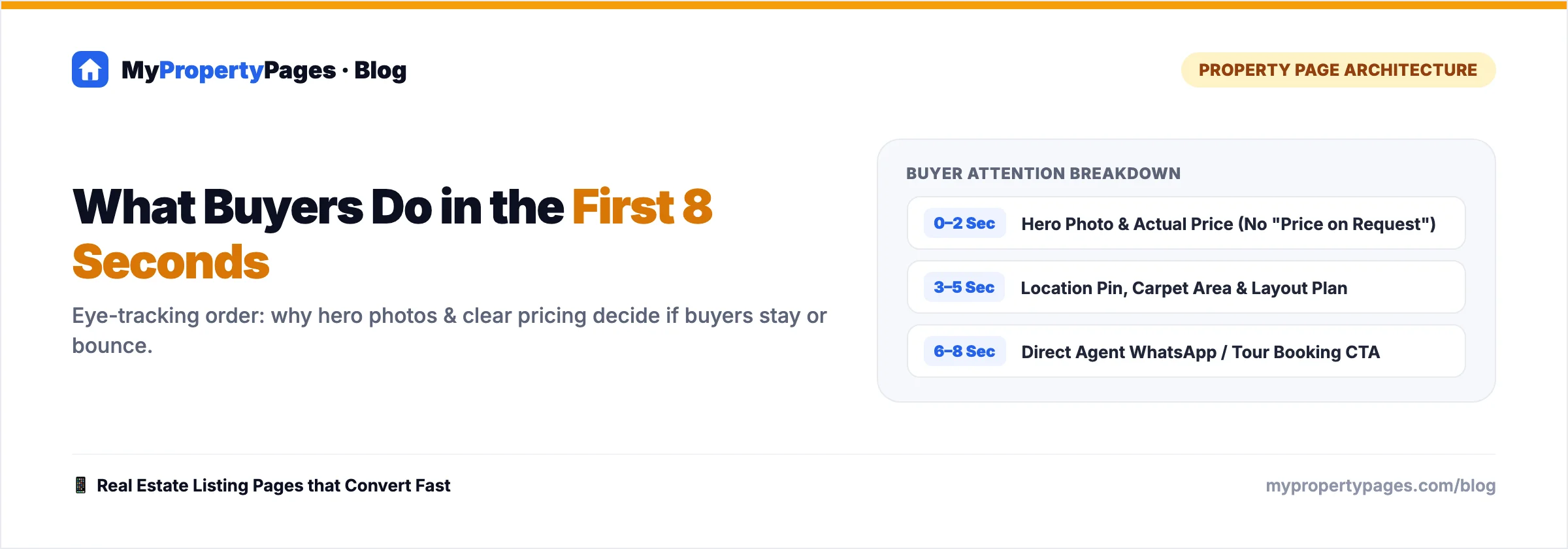
A buyer opening your listing is not reading. They are deciding whether to read. That decision takes about as long as it takes to unlock a phone, and it happens in a predictable order.
The order they actually scan in
The image. Before any text registers, the photograph has already answered a question: is this property in the category I am looking for? Not the price category — the kind of place category. A dark hallway photo says small and old regardless of what the property is. A wide, bright main room says spacious even when the floor area is average.
The price. Immediately after. Not to evaluate it, but to check whether the page is relevant at all. A page that hides this loses people here who never come back.
The location. Specific enough to place. A neighbourhood or district name does this; a city name does not, because the city was already in their search.
The size. Bedrooms, then floor area. In that order, everywhere, regardless of how your market describes property.
Four things. If a buyer can get all four without effort, they scroll. If any one is missing or slow, a meaningful share leave — and they leave without messaging you, so you never learn it happened.
The hero photo is doing more work than the rest of the page
Most agents treat photo selection as picking the nicest picture. It is closer to picking the headline.
Three rules that consistently outperform:
Lead with the largest room, not the exterior. Exteriors say very little unless the building is remarkable. The room where someone will actually spend their evenings tells the buyer whether to imagine themselves there.
Shot at chest height, level. Photographs taken at eye height looking slightly down make rooms look smaller; a level camera at chest height makes them look as they are. Tilting is what makes amateur photos read as amateur, and buyers register it without being able to name it.
Shot with the light, in the middle of the day. Not sunset, whatever the internet says about golden hour. Buyers want to see the property, and dramatic light hides more than it flatters.
If the property genuinely photographs badly — a dark flat, a small studio, a place mid-renovation — lead with the honest best and say what it is. A buyer who arrives at a viewing expecting what the photos promised and finds something else does not buy, and tells people.
What makes people leave
A page that loads slowly. This is the failure agents least believe in and most suffer from. A page carrying twenty full-resolution photographs takes several seconds on a mobile connection, and a large share of buyers never see it at all. Compress before uploading; nobody has ever complained that a listing photo was not high-resolution enough.
A wall of text before the facts. A paragraph of description above the price and size is asking the buyer to read before they know whether to care.
Estate-agent language. "Deceptively spacious", "a rare opportunity", "must be seen to be appreciated" — buyers have learned these mean nothing, and their presence signals that the specifics are being avoided.
A form that asks for too much. Every field beyond name and contact costs enquiries. You can ask the rest once they are talking to you.
What earns the scroll
Once the four essentials are answered, what keeps someone reading is specificity that could not be invented.
The room that gets the afternoon sun. The distance to the station in minutes walked, not kilometres. The fact that the building has visitor parking, or does not. What the monthly charges actually include. Which floor, and whether there is a lift.
These are not selling points in the traditional sense — some of them are drawbacks. That is exactly why they work. A listing that mentions a genuine limitation is read as a listing that is telling the truth about everything else, and the buyer relaxes.
Where those eight seconds actually happen
Almost never on a desktop, and almost never with full attention.
The realistic context is a phone, one hand, a patchy connection, and something else going on — a commute, a lunch break, a television in the background. Every design decision follows from that. Text that reads comfortably on a laptop is small on a phone held at arm's length. A layout that puts the price in a right-hand column has no right-hand column on mobile; it has a place two screens down.
This is also why load time is a conversion issue rather than a technical one. A page that takes six seconds on a mobile connection has already lost most of its eight-second window before anything appears. The commonest cause is photographs uploaded at full camera resolution — a single modern phone image can be several megabytes, and twenty of them is a page nobody on a train will ever see.
Compress before uploading, and check the page on a real phone on mobile data rather than on the office connection. Agents who do this for the first time are frequently surprised, because on the office wifi the page has always been fine.
When the property genuinely photographs badly
Some properties have no good hero shot. A dark basement flat, a studio, a house mid-renovation, a place with a bathroom you would rather nobody saw.
The instinct is to shoot the least bad angle very tightly, which produces a photograph that shows almost nothing. Buyers read that correctly: a listing whose main image is a close-up of a worktop is hiding the room.
Two approaches work better.
Lead with the best true thing, whatever it is. If the flat is dark but the location is exceptional, lead with the street. If the kitchen is dated but large, shoot the size. A buyer who understands what the property's actual strength is can decide whether they want it.
Name the weakness in the first line of the description. "Needs modernising throughout, priced accordingly" filters out everyone who was going to leave in disappointment anyway, and it attracts the specific buyer who is looking for exactly that — a group who currently struggle to find these properties because every listing pretends otherwise.
The properties that sit longest are rarely the worst ones. They are the ones whose marketing set an expectation the viewing could not meet.
The one-screen test
Open your own listing on a phone. Do not scroll. Screenshot what you see.
Can a stranger, from that screenshot alone, say what kind of property it is, what it costs, roughly where it is, and how big?
If yes, the page is working and everything below is a bonus. If not, the rest of the page is decoration, because most of your visitors are deciding from that screenshot and leaving.
Put your next listing on its own page
Free to start: 2 property pages, your agent profile, and every enquiry straight to your phone. The Pages plan adds a sales team, a mini CRM and a follow up bot for $19.99 a month.
Create your free page See a sample agent pageTools & comparisons
Property Portals vs Your Own Landing Page
How lead distribution works on property listing portals, why the same buyer enquiry often reaches several agents, and wh…
ComparePortal Listing vs Your WhatsApp Landing Page
A practical comparison of listing on a property portal against running your own WhatsApp landing page: cost per lead, le…
Free toolsProperty calculators
EMI, stamp duty by state, rental yield, capital gains and more. Free, no sign up.
Keep reading
The Enquiry Form: Every Field You Add Costs You a Buyer
The form is the last thing between an interested buyer and a conversation, and most agents make it the hardest part of the page. What to ask, what to remove, and what to ask later.
Property pagesVideo Walkthroughs That Sell: Length, Shots and Captions
How to shoot video walkthroughs that sell property on a phone: the right length for each platform, a shot list that buyers trust, and captions that bring enquiries.
Property pagesSold Badges and Social Proof: Using Past Deals to Win New Ones
Sold badges and social proof turn your closed deals into your best marketing. How to show past deals, collect reviews and use them to win sellers and buyers.